Sydney Port Logistics [SPL]

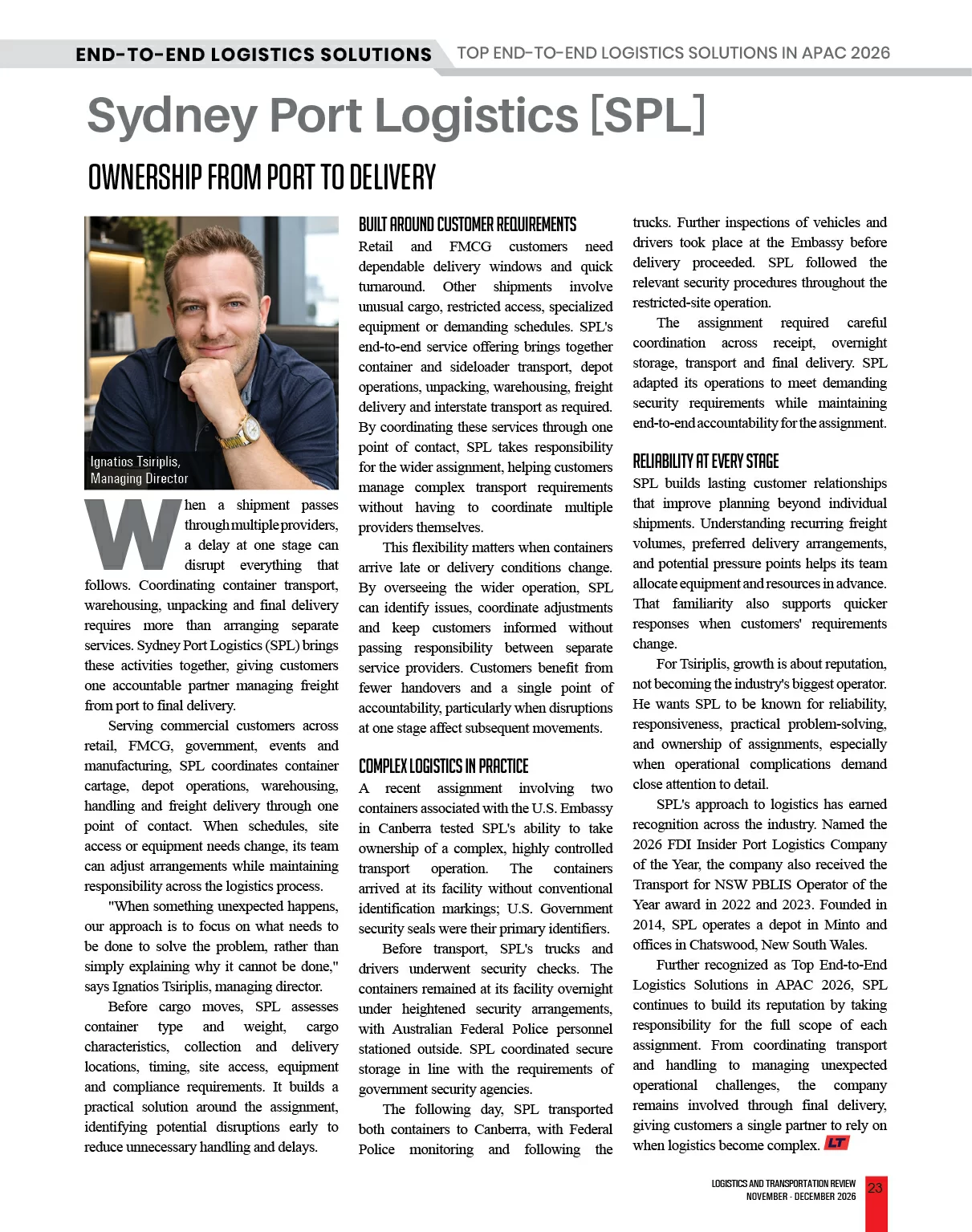
Ignatios Tsiriplis, Sydney Port Logistics [SPL] | Logistics Transportation Review | Top End-to-End Logistics Solutions in APACIgnatios Tsiriplis, Managing Director
When a shipment passes through multiple providers, a delay at one stage can disrupt everything that follows. Coordinating container transport, warehousing, unpacking and final delivery requires more than arranging separate services. Sydney Port Logistics (SPL) brings these activities together, giving customers one accountable partner managing freight from port to final delivery.

Serving commercial customers across retail, FMCG, government, events and manufacturing, SPL coordinates container cartage, depot operations, warehousing, handling and freight delivery through one point of contact. When schedules, site access or equipment needs change, its team can adjust arrangements while maintaining responsibility across the logistics process.

"When something unexpected happens, our approach is to focus on what needs to be done to solve the problem, rather than simply explaining why it cannot be done," says Ignatios Tsiriplis, managing director.

Before cargo moves, SPL assesses container type and weight, cargo characteristics, collection and delivery locations, timing, site access, equipment and compliance requirements. It builds a practical solution around the assignment, identifying potential disruptions early to reduce unnecessary handling and delays.

Built Around Customer Requirements

Retail and FMCG customers need dependable delivery windows and quick turnaround. Other shipments involve unusual cargo, restricted access, specialized equipment or demanding schedules. SPL's end-to-end service offering brings together container and sideloader transport, depot operations, unpacking, warehousing, freight delivery and interstate transport as required. By coordinating these services through one point of contact, SPL takes responsibility for the wider assignment, helping customers manage complex transport requirements without having to coordinate multiple providers themselves.

This flexibility matters when containers arrive late or delivery conditions change. By overseeing the wider operation, SPL can identify issues, coordinate adjustments and keep customers informed without passing responsibility between separate service providers. Customers benefit from fewer handovers and a single point of accountability, particularly when disruptions at one stage affect subsequent movements.

Complex Logistics in Practice

A recent assignment involving two containers associated with the U.S. Embassy in Canberra tested SPL's ability to take ownership of a complex, highly controlled transport operation. The containers arrived at its facility without conventional identification markings; U.S. Government security seals were their primary identifiers.

  • When something unexpected happens, our approach is to focus on what needs to be done to solve the problem, rather than simply explaining why it cannot be done.

Before transport, SPL's trucks and drivers underwent security checks. The containers remained at its facility overnight under heightened security arrangements, with Australian Federal Police personnel stationed outside. SPL coordinated secure storage in line with the requirements of government security agencies.

The following day, SPL transported both containers to Canberra, with Federal Police monitoring and following the trucks. Further inspections of vehicles and drivers took place at the Embassy before delivery proceeded. SPL followed the relevant security procedures throughout the restricted-site operation.

The assignment required careful coordination across receipt, overnight storage, transport and final delivery. SPL adapted its operations to meet demanding security requirements while maintaining end-to-end accountability for the assignment.

Reliability at Every Stage

SPL builds lasting customer relationships that improve planning beyond individual shipments. Understanding recurring freight volumes, preferred delivery arrangements, and potential pressure points helps its team allocate equipment and resources in advance. That familiarity also supports quicker responses when customers' requirements change.

For Tsiriplis, growth is about reputation, not becoming the industry's biggest operator. He wants SPL to be known for reliability, responsiveness, practical problem-solving, and ownership of assignments, especially when operational complications demand close attention to detail.

SPL's approach to logistics has earned recognition across the industry. Named the 2026 FDI Insider Port Logistics Company of the Year, the company also received the Transport for NSW PBLIS Operator of the Year award in 2022 and 2023. Founded in 2014, SPL operates a depot in Minto and offices in Chatswood, New South Wales.

Further recognized as Top End-to-End Logistics Solutions in APAC 2026, SPL continues to build its reputation by taking responsibility for the full scope of each assignment. From coordinating transport and handling to managing unexpected operational challenges, the company remains involved through final delivery, giving customers a single partner to rely on when logistics become complex.

Deep Dive

One Point of Control for End-to-End Logistics

Freight can quickly become difficult to manage when too many parties are involved. A container might move from port collection to storage, unpacking, linehaul and final delivery, with each handoff bringing a new schedule, contact, system or set of assumptions. For buyers, the real concern is whether a provider can keep the entire process under control and stop one delay from affecting everything that follows. The range of services a provider offers should be considered in the context of the actual movement requirements. A provider that handles transport but cannot support warehousing, depot operations, unpacking or specialized handling may still leave the buyer coordinating several important steps. What matters is not how long the service list is, but whether the provider can bring the necessary functions together under one plan and remain accountable when cargo, schedules or site conditions change. Physical constraints can make or break that plan. Container type and weight, site access, equipment needs and delivery windows can all affect how a movement is organized, sometimes before the truck even leaves the yard. Buyers should look at how a provider gathers this information and uses it to plan each stage of the movement. Standard processes may work well for predictable freight, but they can fall short when site access is restricted or handling requirements change at short notice. “Sydney Port Logistics uses one point of contact to coordinate the chain and adjusts the plan when timing, site access, cargo constraints or equipment requirements change.” A provider's ability to respond becomes particularly important when things do not go as planned. Port delays, late container availability, changes in site access and equipment substitutions can disrupt everything that follows. Having control over the connected services allows a provider to adjust the plan without leaving the customer to coordinate multiple contractors. This also helps avoid information gaps and gives the buyer a clear point of contact and accountability. Keeping information moving between all parties is another challenge when several people are involved in the same shipment. Updates may come through different systems or individual contacts, leaving the buyer to piece together what has happened and what needs to happen next. A provider overseeing more of the process should be able to keep each handoff visible without adding to the customer's administrative workload. This becomes especially important when a late port release affects a warehouse booking or final delivery window. Buyers should understand who picks up on the change, who takes responsibility for responding, who approves the revised plan and how quickly the updated instructions reach the people handling the next stage. Over time, a provider's familiarity with the customer's freight requirements can make planning easier. Regular shipment volumes, delivery preferences, seasonal demands and recurring site restrictions become easier to anticipate when the same provider is involved across movements. Buyers with ongoing freight requirements should look beyond the price of individual jobs and consider how well a provider retains an understanding of their needs from one movement to the next. Having to explain the same requirements every time can create unnecessary coordination work. Sydney Port Logistics builds each movement around the full requirement, combining container and sideloader transport with warehousing, unpacking, freight delivery, interstate transport and other supporting services as needed. Sydney Port Logistics uses one point of contact to coordinate the chain and adjusts the plan when timing, site access, cargo constraints or equipment requirements change. This reduces the coordination burden carried by the customer. The model is particularly relevant for buyers whose freight crosses several service steps and who need one provider to retain responsibility from initial receipt through final delivery. Its attention to detail and problem solving also suits time-sensitive or unusual movements where standard processes are unlikely to hold. ...Read more
Share this Article:

Company
Sydney Port Logistics [SPL]

Management
Ignatios Tsiriplis, Managing Director

Description
Sydney Port Logistics delivers integrated logistics solutions across container transport, port operations, warehousing, unpacking and freight delivery. Known for operational ownership and problem solving, the company helps customers manage complex, time-sensitive movements through a single point of contact and tailored end-to-end coordination.